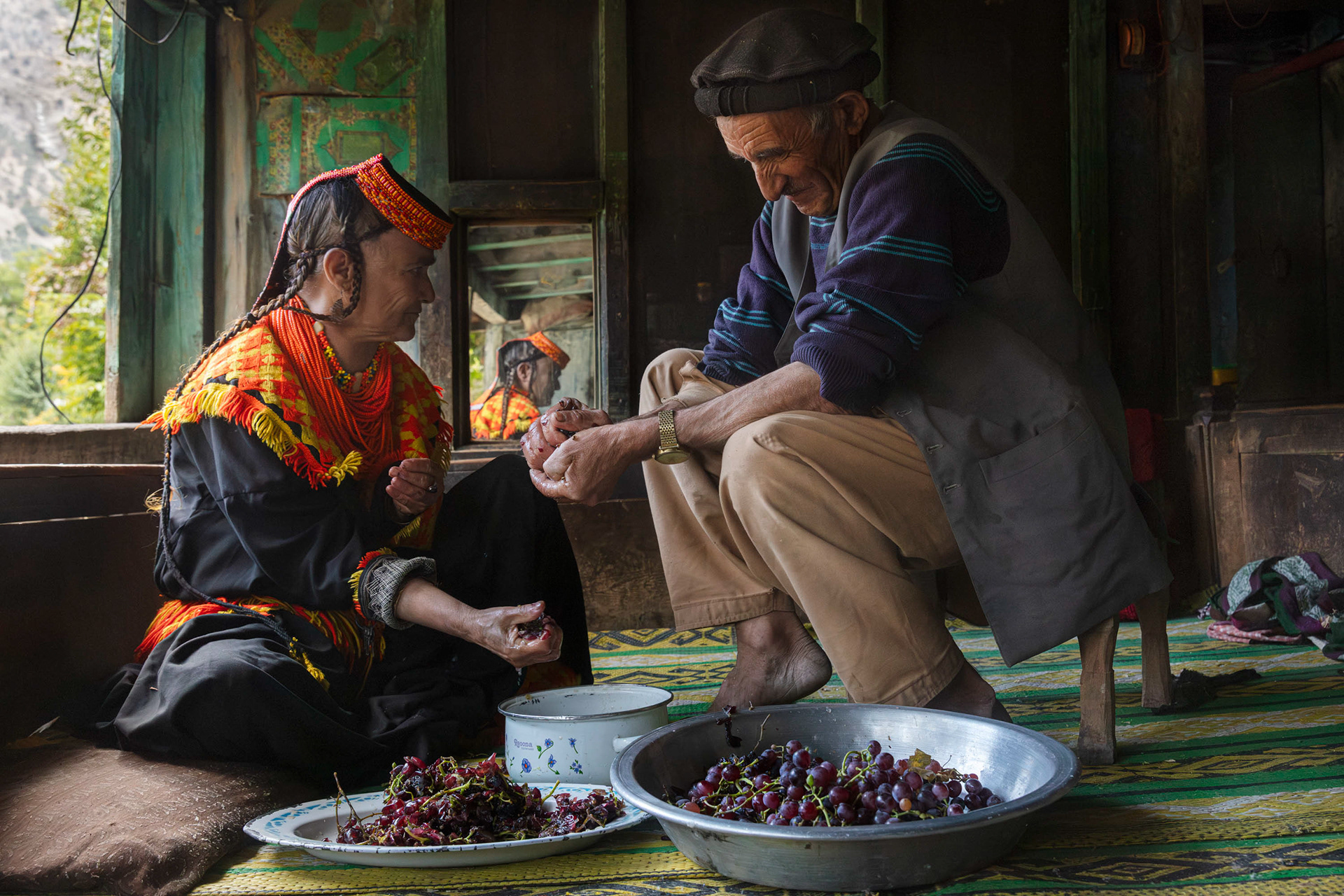
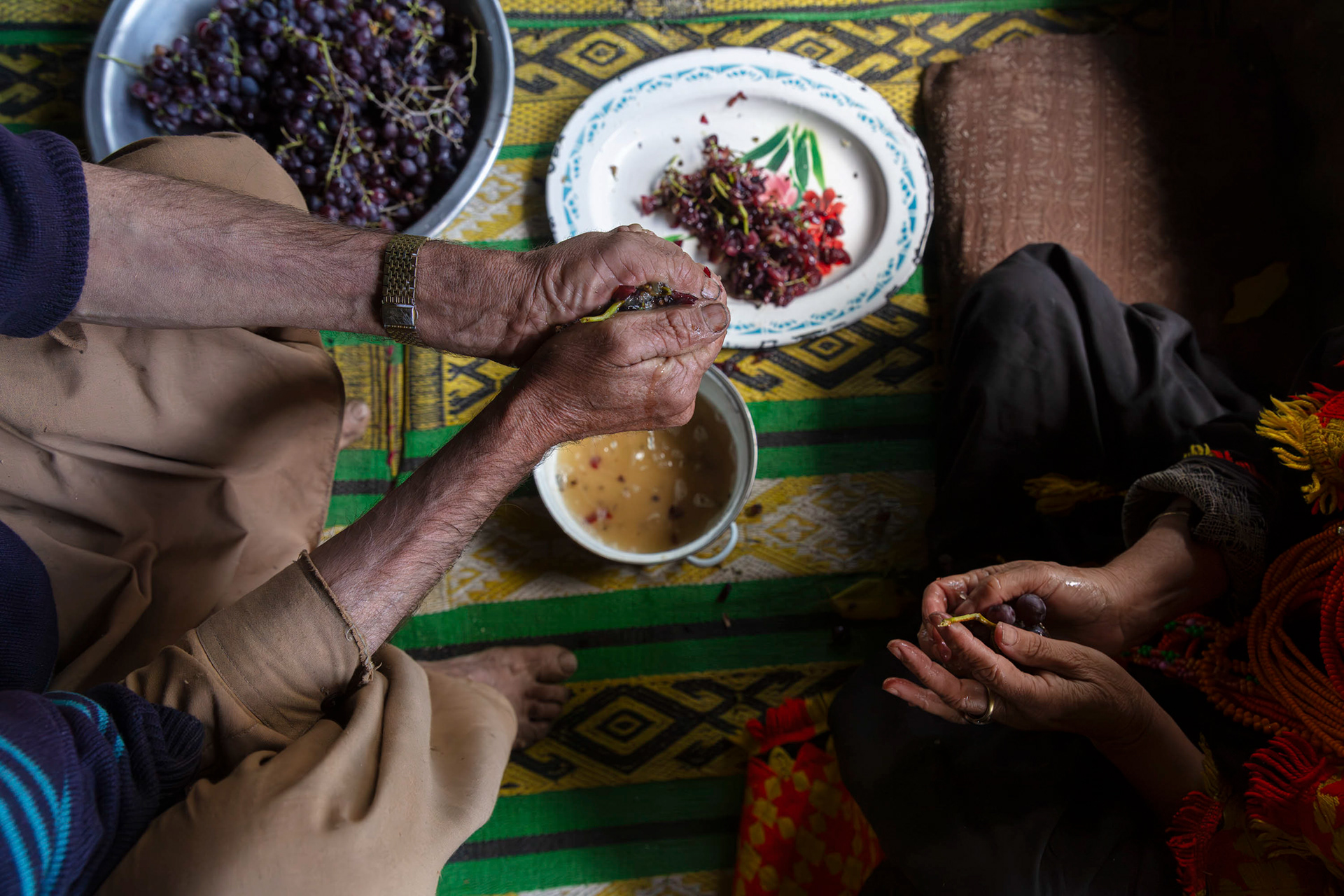
Kui Begum helps her husband during the traditional winemaking process. It is a practice shared among families in Bumburet Valley in Anish Village, KPK, Pakistan. 

After over a millennia, wine remains central to the Kalash people’s rituals and everyday life—even in a Muslim country that heavily restricts alcohol.
By Shehzil Zahid
Photography by Komal Ghazaali
In Birir Valley, northern Pakistan, grape-picking is prohibited during the summer months to prevent premature harvesting. Yields have decreased from climate change-induced glacial flooding, so the precious fruit must ripen to its fullest. Come fall, the Kalash, an ethnoreligious people of roughly 4,000, celebrate the Phō Festival and collect the black grapes in large wooden troughs. Virgin boys and men climb inside and trample the fruit with their freshly cleaned feet, and the juice is stored in airtight plastic drums to ferment for up to a month. 
Once developed, the wine, or da in Kalasha, is tart and sweet. 

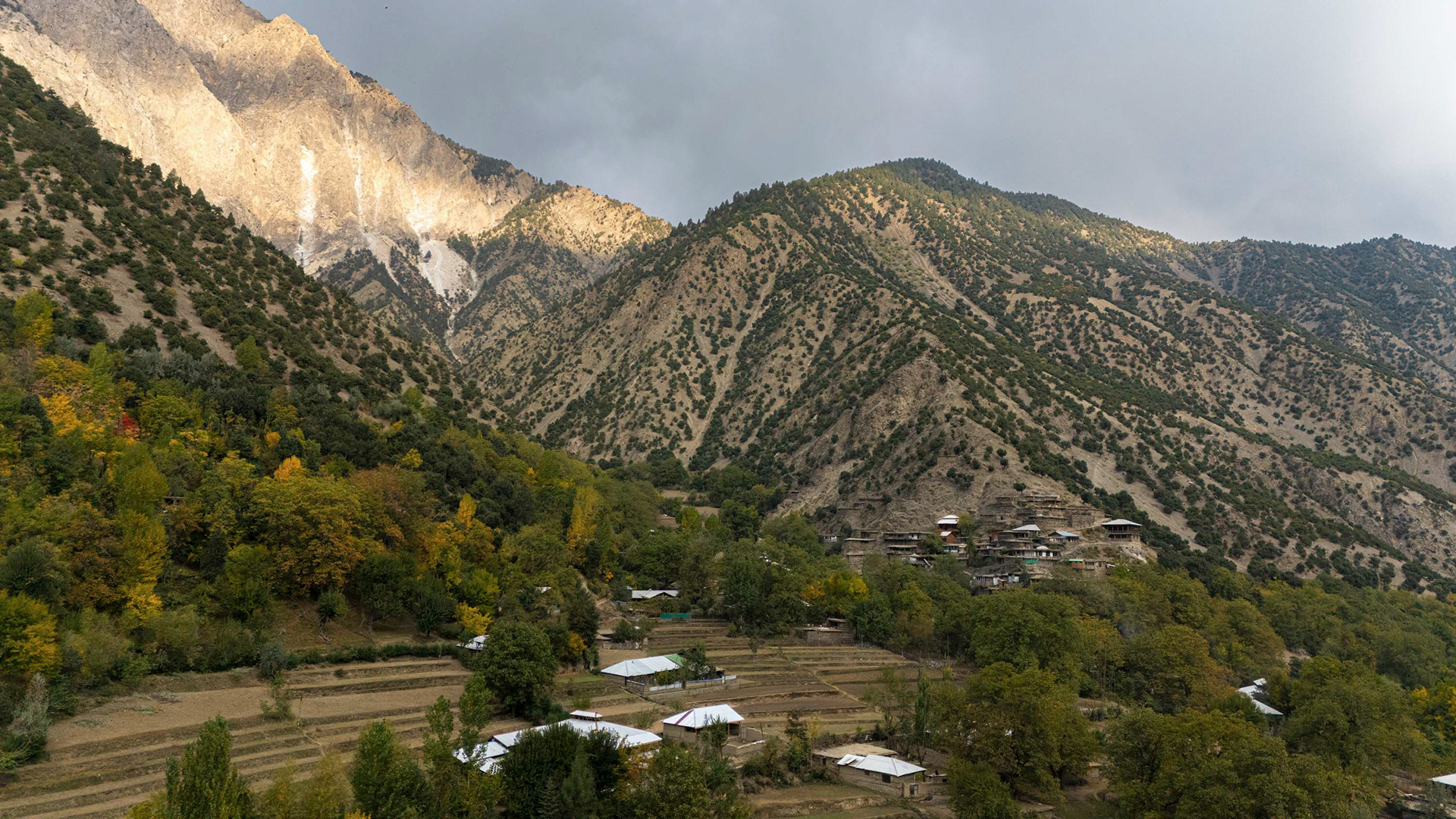
View of an Anish Village, KPK, Pakistan. 
“Kalash wine is very sharp compared to the black market French wine in Pakistan—the French wine is very dull,” says Zeeshan, a documentary filmmaker who agreed to be identified only by first name due to consumption being a crime in Pakistan.
For over a millennia, the winemaking traditions of the Kalash have endured in Pakistan’s rugged Hindu Kush mountains. Wine is central to religious celebrations and rituals, and its sale helps provide income to a tourism-reliant community in a Muslim country that heavily restricts alcohol. 

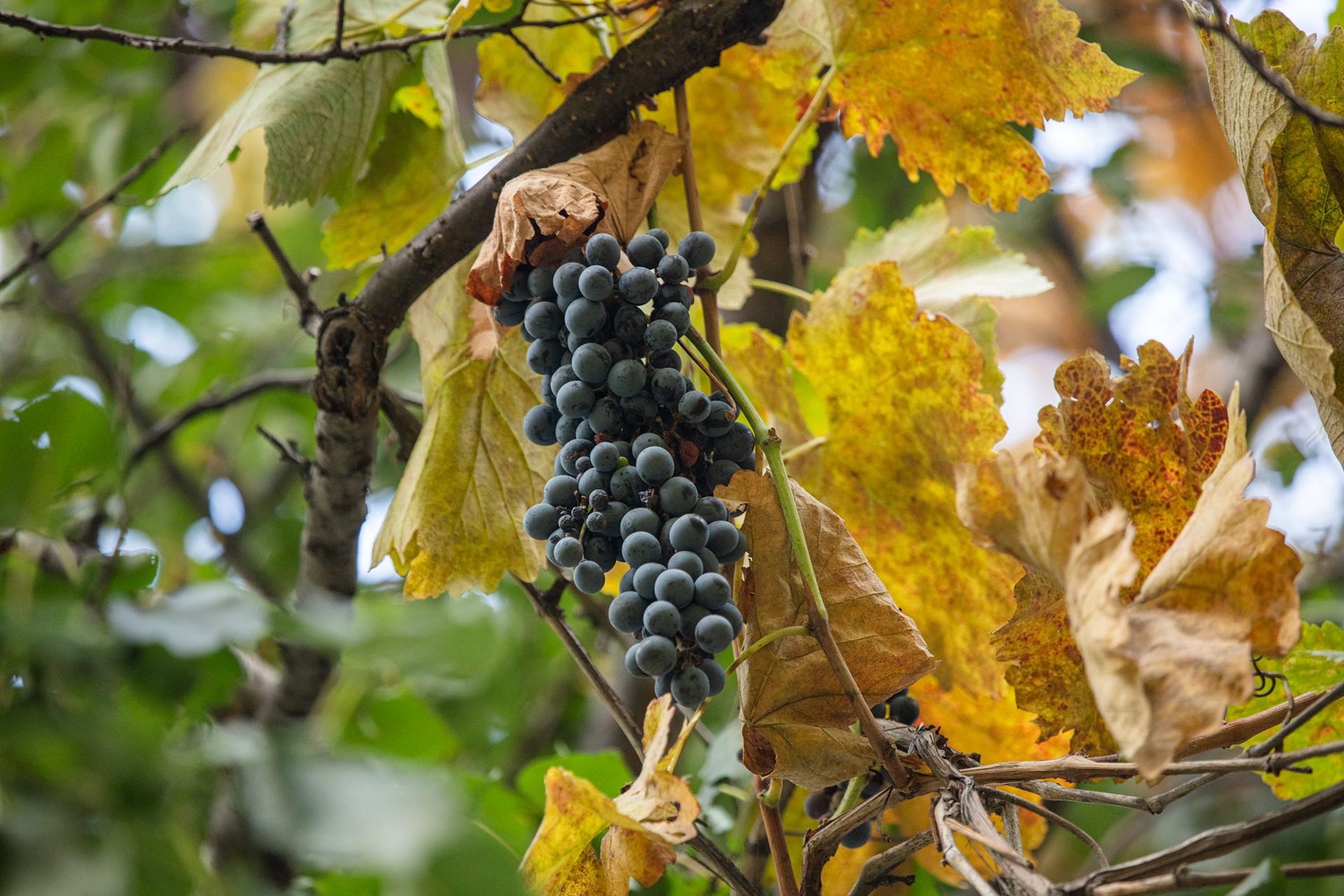
In the Kalasha valleys, including Bumburet, grapes from home orchards are cultivated for traditional winemaking, Anish Village, KPK, Pakistan. 
Sayed Gul Kalash, a field officer for the Directorate of Archaeology and Museums in Pakistan’s Khyber Pakhtunkhwa (KPK) province, explains the Kalash are an ethnoreligious people in the Birir, Bumburet, and Rumbur valleys of Lower Chitral District, KPK. The valleys are nestled in the formidable Hindu Kush mountain range, one of the most remote regions in the world. Nearby, in Pakistan’s Karakoram range, is K2, every serious mountaineer’s white whale.

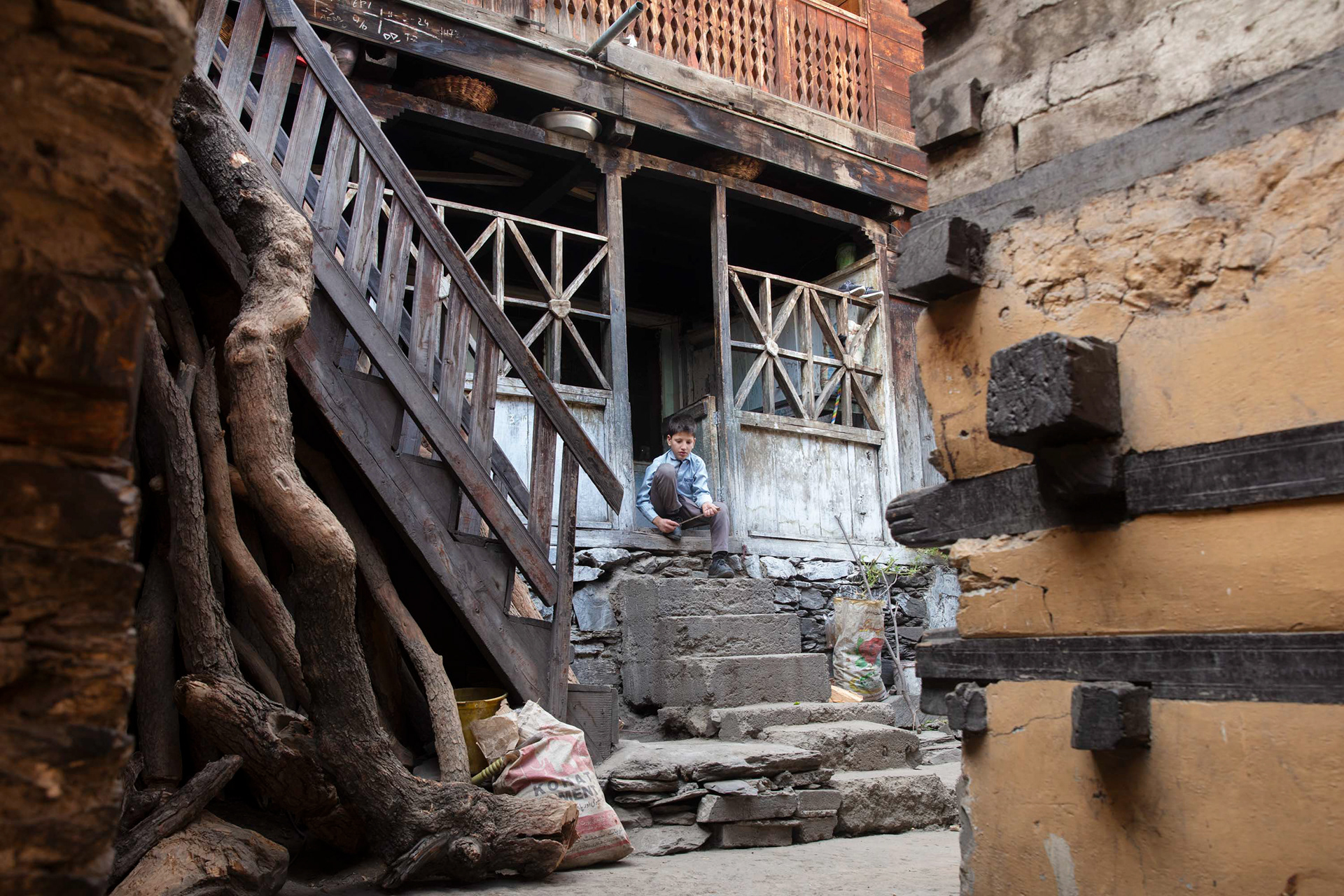
A Kalasha child, Shayan Jabaar, sits outside his home in Karakal Village, Bumburiet Valley, after returning from school. 
Gul Kalash says the Kalash practice shamanism and worship in seasonal festivals through song, dance, wine, and sacrificial offerings. With no religious texts, beliefs and customs are passed down orally, and while rituals may vary among the valleys, core beliefs and tenets hold strong.
“Only the Birir Kalash celebrate the Phō Festival, but da is sacred for all Kalash,” says Gul Kalash, who is also an activist and cultural ambassador for the community. “We all drink wine at our festivals and purify our hands and the knife with wine before sacrificing the goats. We also sprinkle wine to purify our spaces.”

Hand-squishing grapes marks the beginning of the traditional winemaking process in Bumburet Valley for household consumption. Photo taken in Anish Village, KPK, Pakistan. 
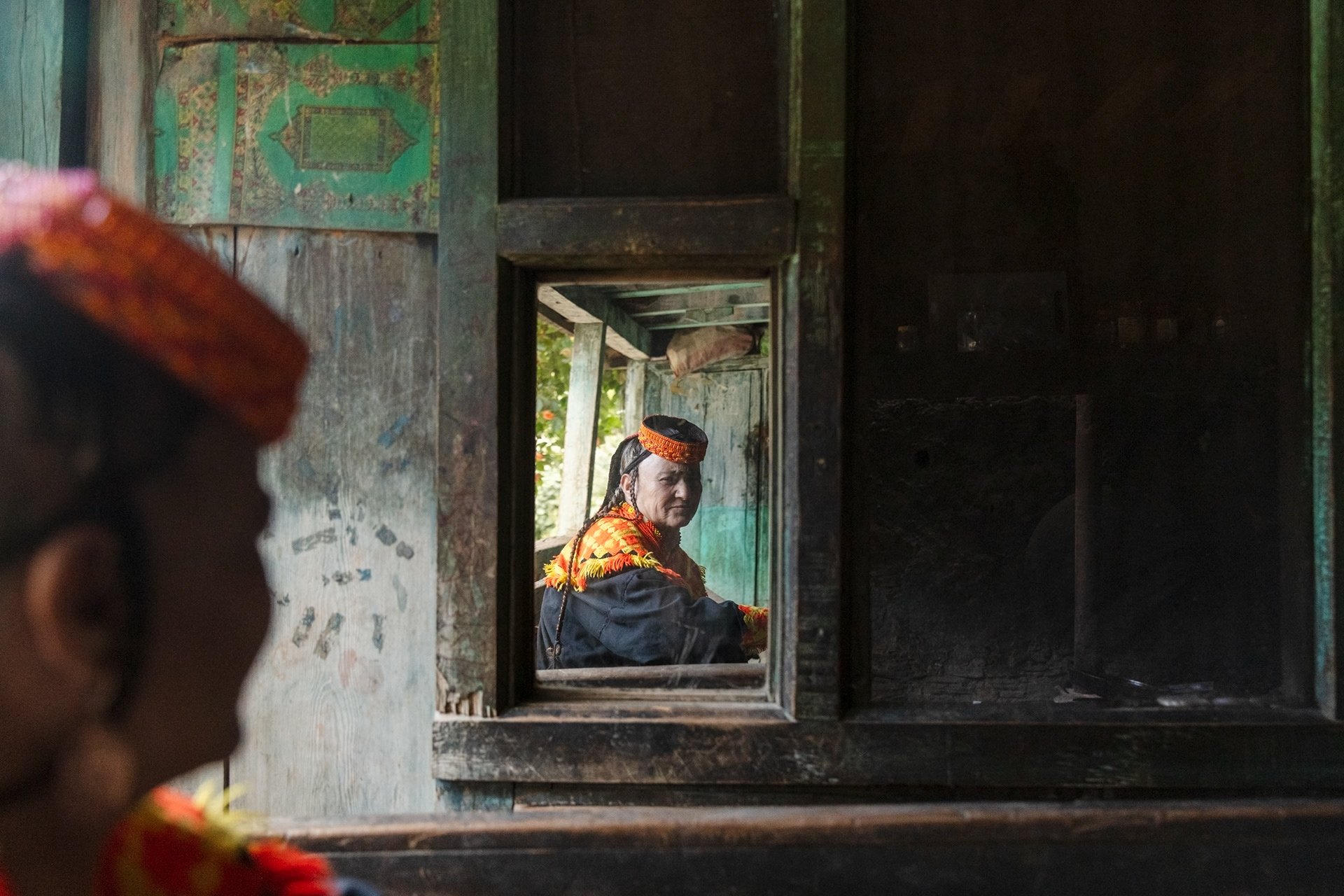
Kui Begum, Anish Village, KPK, Pakistan
As a Muslim country, Pakistan heavily restricts alcohol. Murree Brewery and Hui Coastal Brewery are its only legal commercial manufacturers, both licensed to sell exclusively to non-Muslims and through licensed outlets. However, licensed retailers sell discreetly to Muslims, home-brewing is secretly practiced, alcohol is available on the black market, and the Kalash are allowed to make and consume wine for religious reasons.

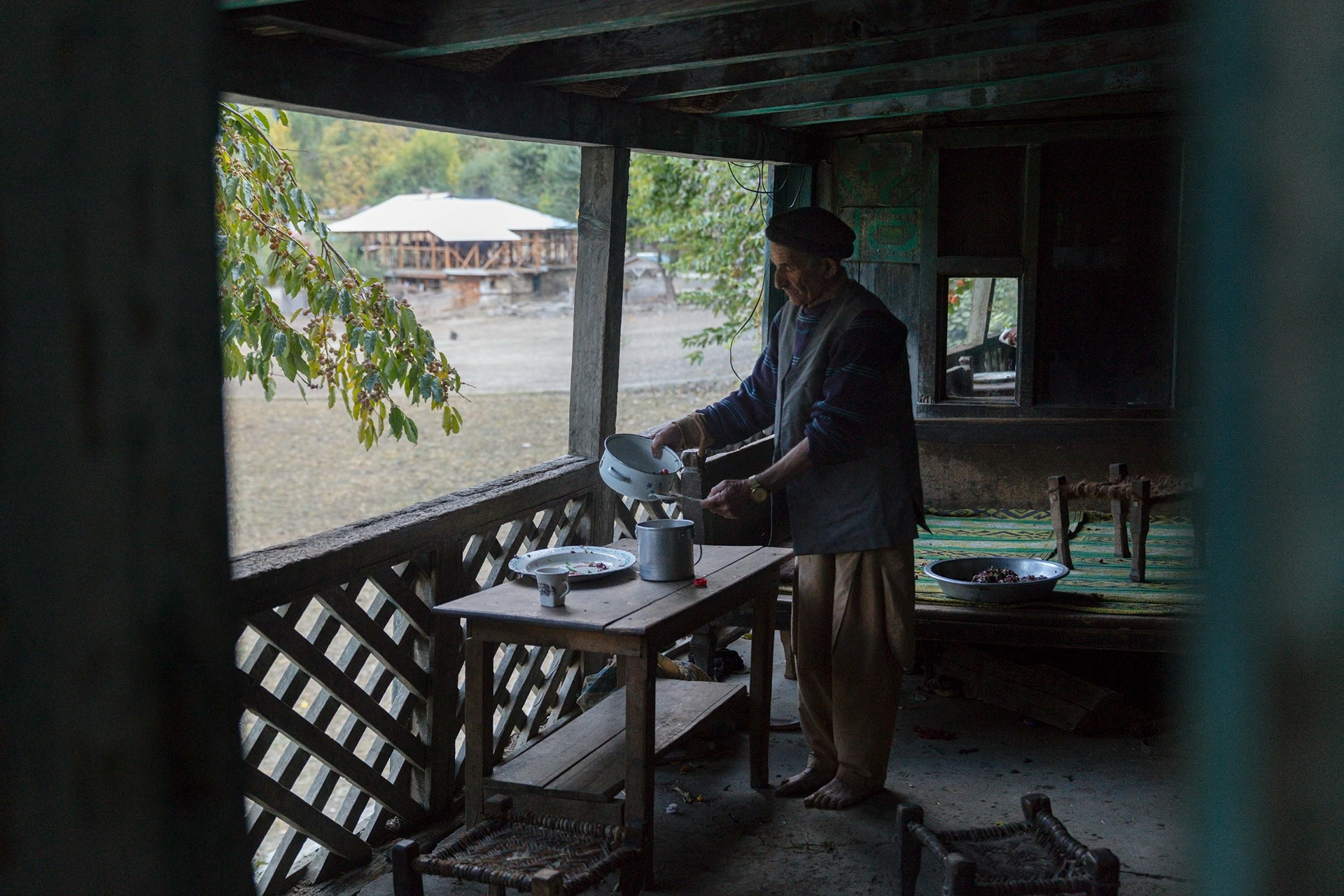
At his home in Anish Village, Sarfaraz Khan carries out the traditional process of winemaking.
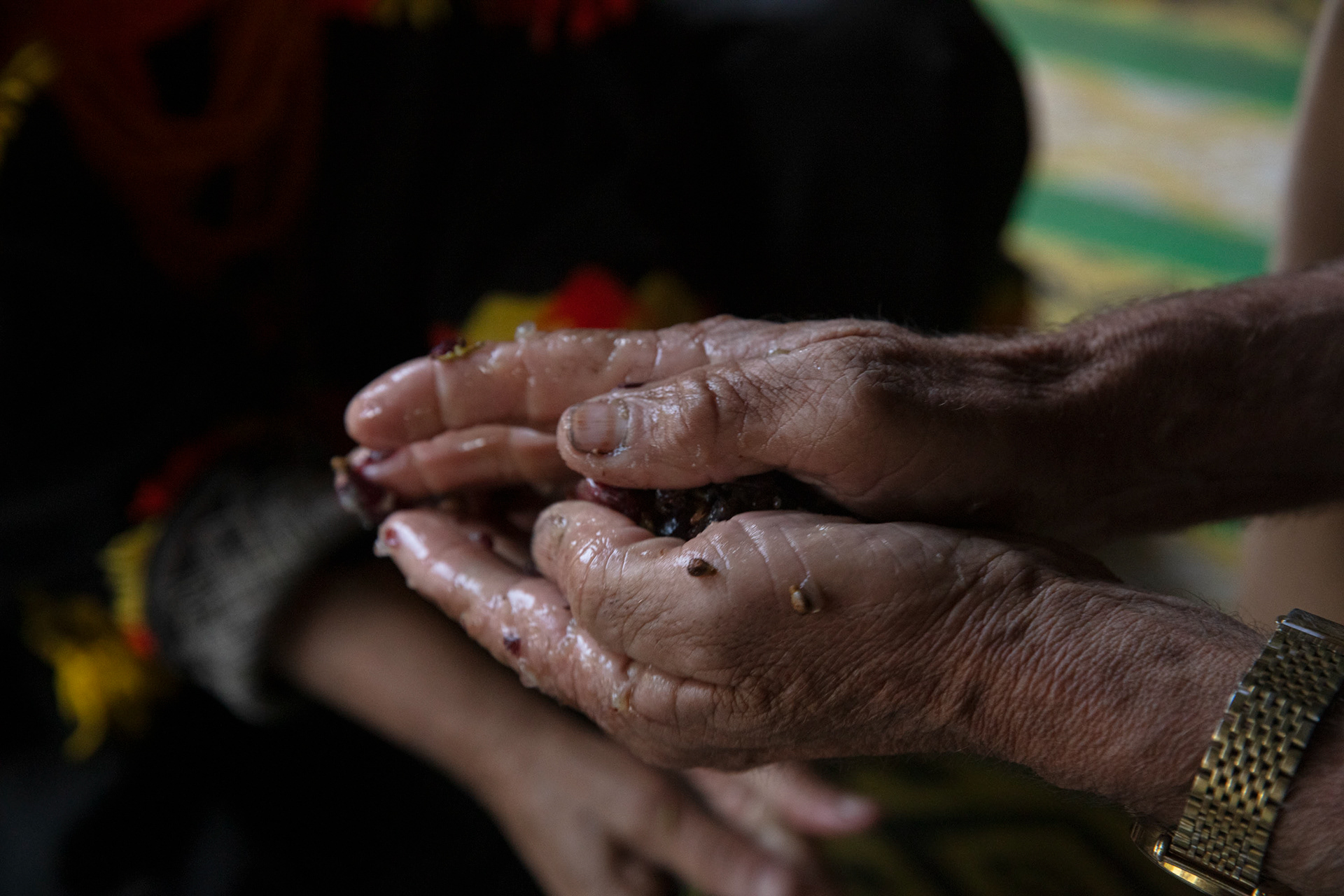
Hand-extracting juice from homegrown grapes in Anish Village, Bumburet Valley, Khyber Pakhtunkhwa, Pakistan. 
Gul Kalash says that according to tradition, a powerful shaman in Bumburet once struck his head to the ground, dug through, and emerged in Birir with a cluster of grapes picked from heaven. Declaring the fruit pure, he decreed that all Kalash must use it and its juice in their religious rituals.
Dr. Muhammad Kashif Ali, a historian at the University of Gujrat in Gujrat, Pakistan, has studied the Kalash for the last 20 years. He explains that their cosmological world is understood through purity and impurity.

After extraction, the juice is filtered using a common household strainer so the grape residue is separated out. Photo taken in Anish Village, Bumburet Valley, KPK, Pakistan. 
“This concept is applied spatially. Upper spaces are pure and lower spaces are impure,” says Dr. Ali. “Mountain peaks are pure; sacrificial offerings are made in higher pastures. Similarly, the depths of valleys and riverbeds are impure. People, animals, and items can be pure or impure, but they can also be purified.”
“Purification is compulsory,” says Faizi Khan, the grizzled owner of a modest guesthouse in Bumburet, where winemaking is domestic rather than communal. Khan’s stock from this season is fermenting in a drum covered with several layers of blankets in a tiny windowless storage room in his guesthouse.

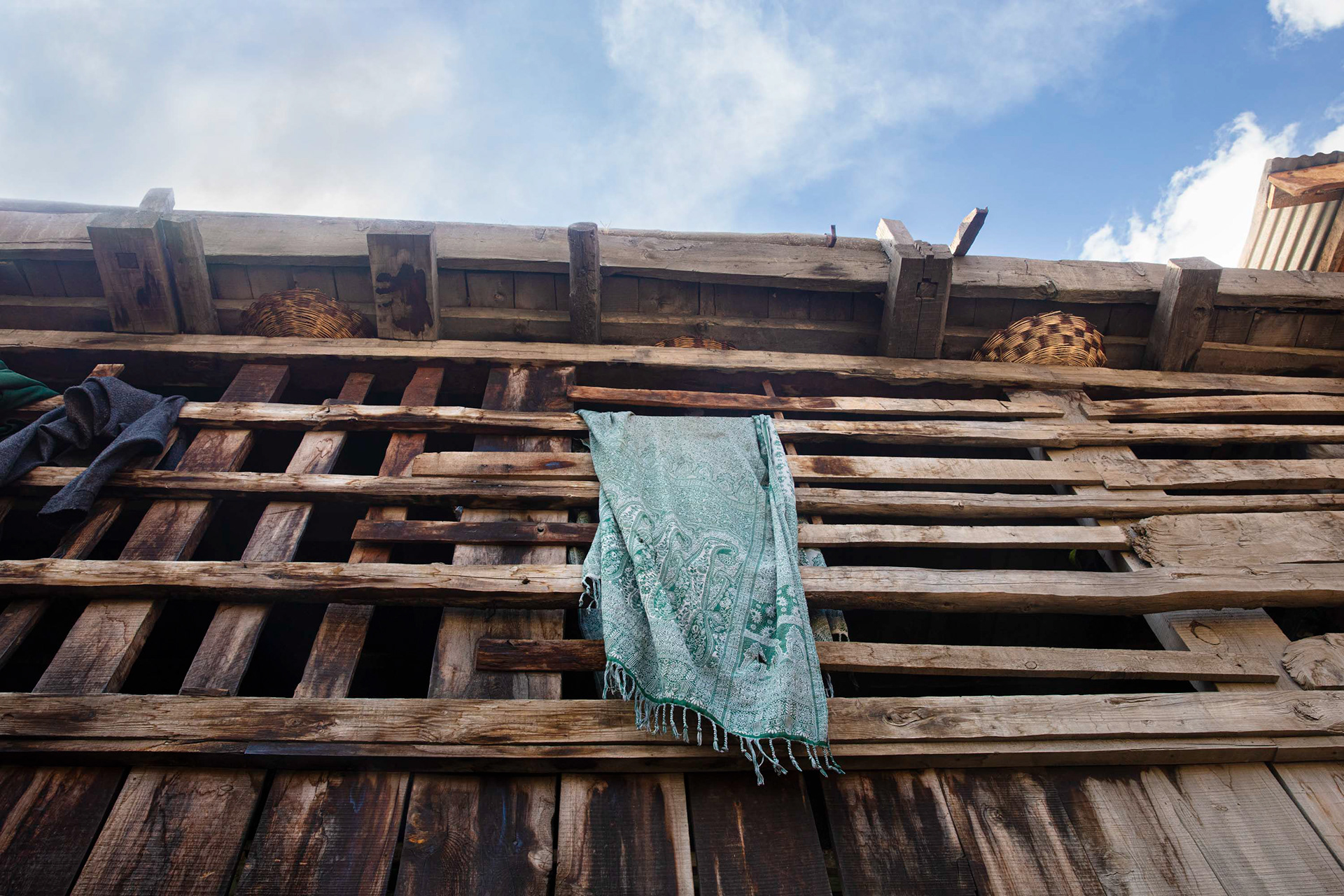
A stole hangs outside a house in Karakal Village. A very common sight as locals dry out their laundry in the mountain air, KPK, Pakistan. 
“Not every family makes wine, but every household has some for purification.” 
While the Kalash drink wine socially, Khan says its alcoholic content is low, at most at 6% or 7%, and drinking to intoxication is deeply discouraged. He adds that it is also used to sanitize their hands and utensils, as well as treat wounds—sanitizers were not easily available in the region pre-Covid-19. 
With wine so central to everyday life, the community learns how to make wine as children under parental supervision, says Imran Kabir, a trader who ferments roughly 50 to 60 litres of wine annually. 
“It’s a delicate balance of feeding the yeast enough oxygen and maintaining carbon dioxide levels. The slightest miscalculation will spoil the wine, the drum can burst, and then your efforts are all wasted—or worse, make someone very ill,” says Kabir. “We used to use the p’hund (a traditional underground stone silo), but we don’t make enough wine anymore, and its upkeep is harder.” 

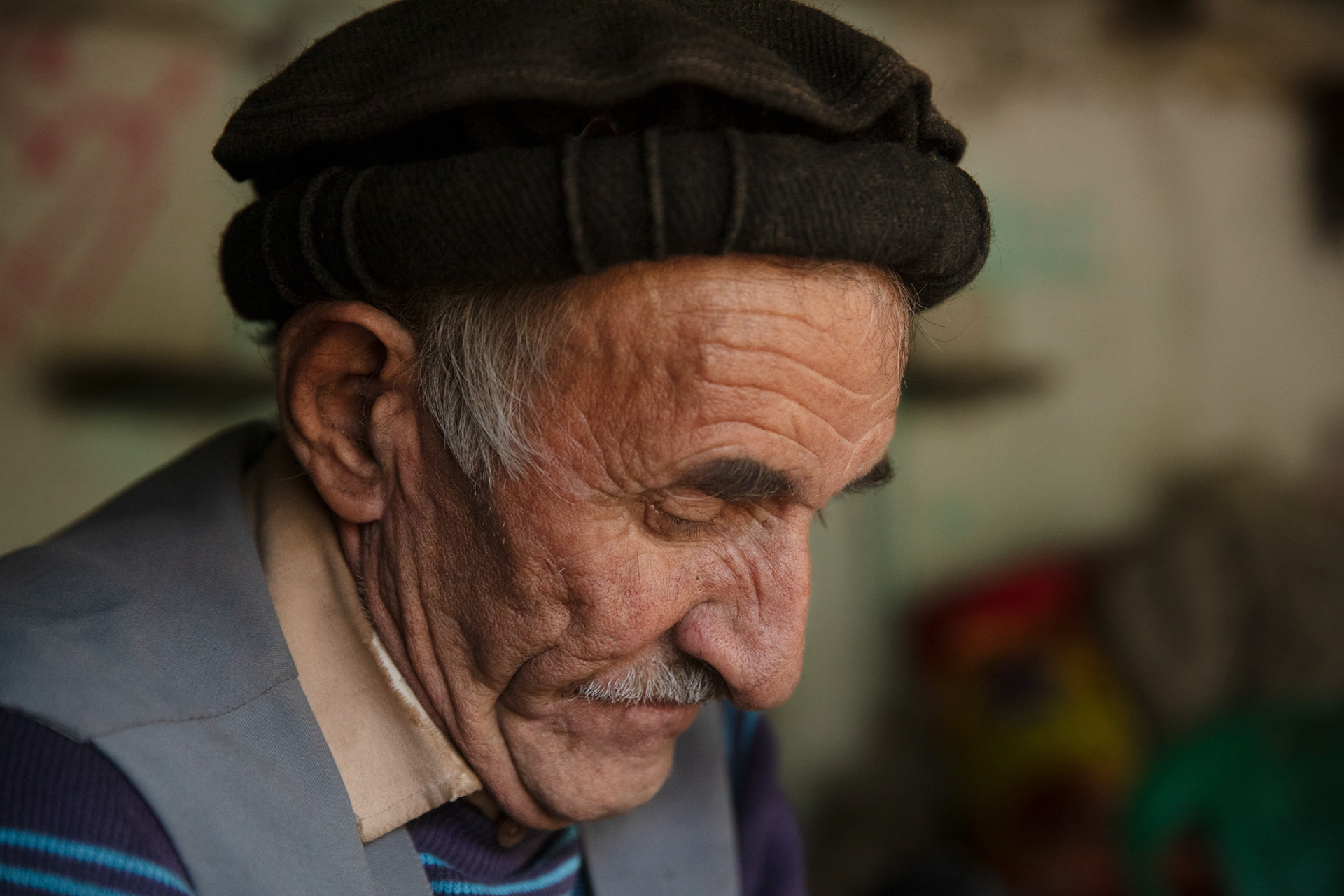
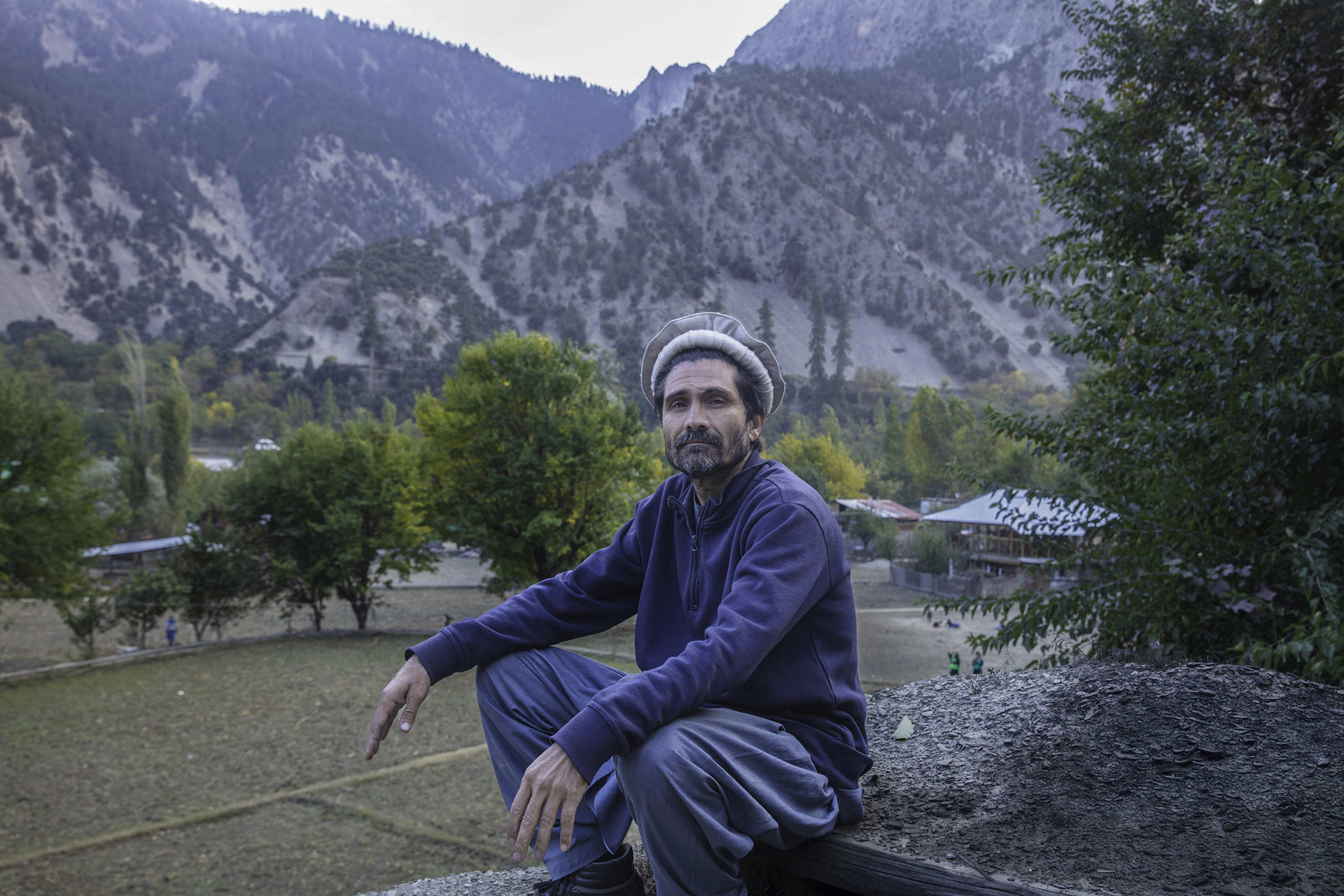
Portrait of Imran Kabir — a resident of Bumburet Valley who makes wine at home following Kalasha tradition. Anish Village, Bumburet Valley, KPK, Pakistan. 
Secret Origins, Seasonal Livelihoods
Little is definitively known about the Kalash’s origins. Kabir says oral tradition recalls Tsiyam, a mythical ancestral homeland. Dr. Abdul Samad, Secretary of Tourism, Culture, Archeology, and Museum Department, KPK, says researchers once believed they descended from Alexander the Great’s Greek armies leading campaigns through the Indian subcontinent between 327 and 325 BCE. 
“Genetic testing and archaeological evidence show their ancestral line predates Alexander the Great,” says Dr. Samad, who has conducted archaeological digs in Chitral. “They are a totally indigenous community.”
Dr. Ali says the Kalash likely migrated from present-day Nuristan, Afghanistan, some 1,500 to 2,000 years ago, to the Chitral region, where they have lived as both rulers and the ruled. Through changing dynasties, empires, boundary lines, and governments over the last 300 or so years, the Kalash have experienced forcible mass conversions and gradual, voluntary ones.
Birir, Bumburet, and Rumbur are the last holdouts.

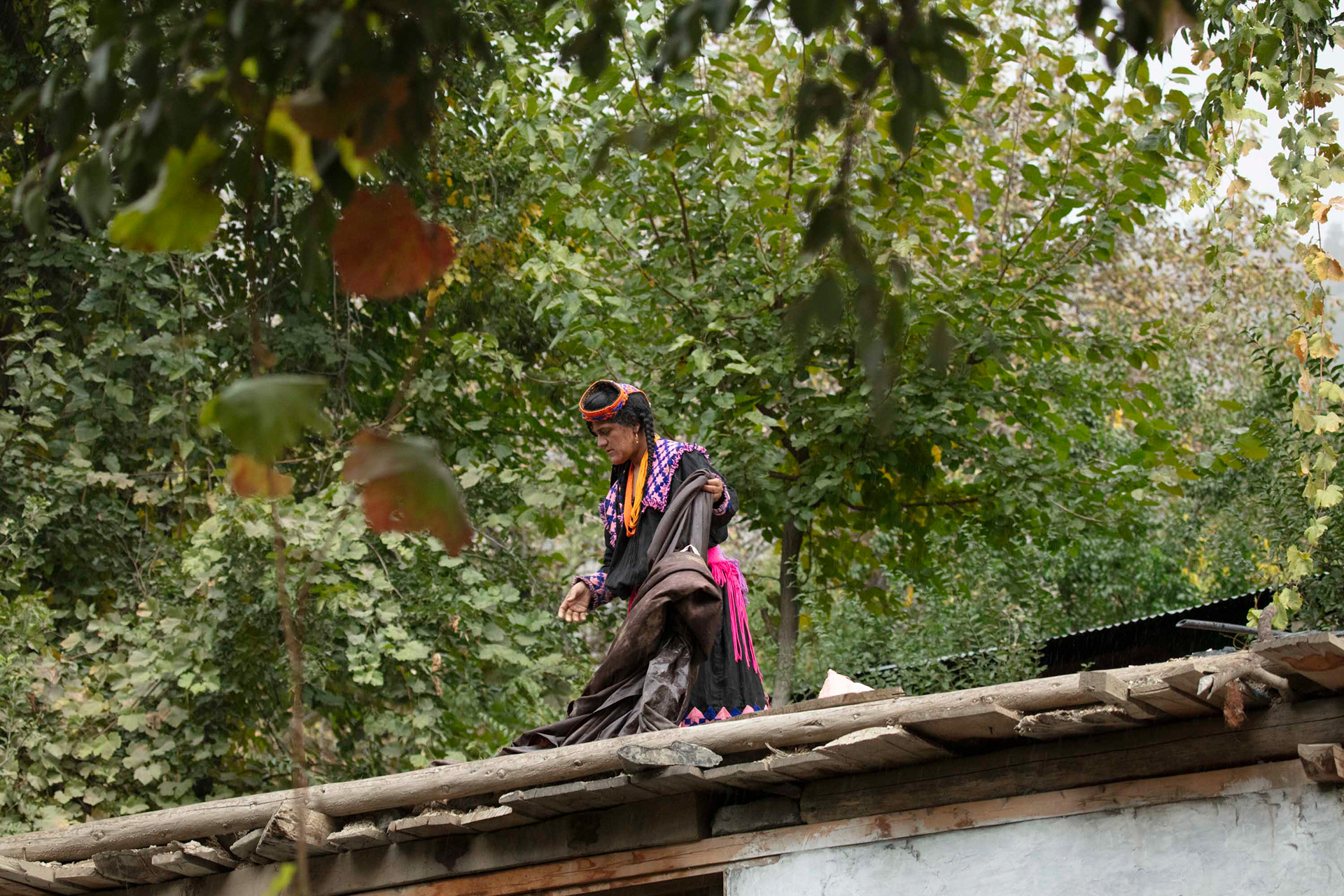
Noor Zarin, Daras Guru Village, Bumburet Valley, KPK, Pakistan. 

Traditionally pastoralists, the Kalash economy changed when the first jeep route was carved through Pakistan’s Hindu Kush in the 1970s, says Dr. Ali. Although passage meant tottering at the edge of a steep cliff, the road invited local and foreign tourists to experience the country’s last pre-Islamic people and their festivals. Some Kalash now also earn from seasonal tourism as guesthouse owners, drivers, guides, and craftsmen, more so in Bumburet than in Birir or Rumbur.  
Khan and Kabir say in this relatively new economy, some sell wine and tara—moonshine, made from mulberries and apricots—under the table in recycled soda bottles to local and foreign tourists seeking a taste of indigenous alcohol in dry Pakistan. Prices aren’t fixed, earnings are just enough to get by, and it’s a risky endeavor with consequences that could land them in jail or result in harassment from neighboring Muslim communities.
But with few other opportunities, Khan says their hands are tied. 
“There’s no business here. There’s no industry here for people to work,” says Khan. “This is how our people make a living and buy bread. This is how our lives go on.”
In deeply conservative Pakistan, the heavy restrictions limit the average Pakistani’s experience with alcohol. Coupled with the misconceptions about the Kalash—that as non-Muslims, they are as liberal as Westerners—problems often arise.
“Although tara is strong, some people are drunk, then some people act drunk,” says Khan. “Then there are some people who are stupid, and they harass our girls and women, especially around our festivals. They mistake their dancing as something else when it’s really just our worship.”
Offended by such behavior, the small community has grown wary; Gul Kalash says some villages avoid selling altogether, while others continue discreetly.